Showing posts with label News. Show all posts
Thursday, July 16, 2015

Amid Political Competition, ‘Culture of Dialogue’ May Not Last, Analysts Say


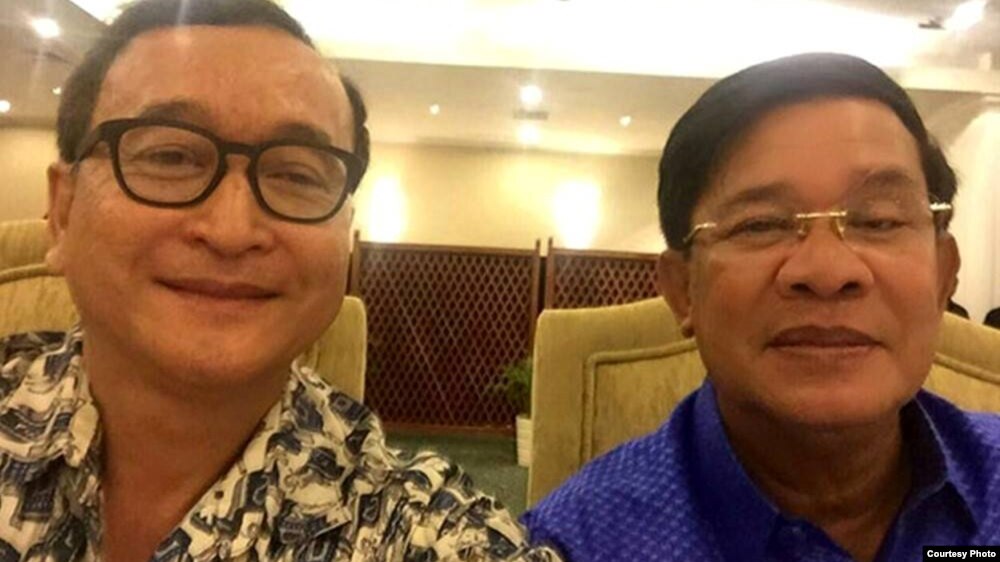
A widely shared photo on Cambodian social media, Cambodian opposition leader Sam Rainsy and Prime Minister Hun Sen take a selfie to affirm their 'culture of dialogue' at a dinner between the two families at Cambodiana Hotel in Phnom Penh, Sunday, July 12, 2015. (Courtesy of Sam Rainsy)
When Prime Minister Hun Sen and opposition leader Sam Rainsy sat down together for dinner with their families one recent Saturday evening in Phnom Penh, they touted a continued “culture of dialogue” as a reason for their new apparent friendliness.
Indeed, coming just one year after major violent clashes between opposition supporters and Phnom Penh security personnel, the dinner signifies a new environment.
But political analysts say that the “culture of dialogue” mainly benefits the ruling Cambodian People’s Party and is unlikely to last, given that both sides, in reality, are still vying for control of the country’s political landscape.
“I think these close relations are only temporary,” Ou Virak, head of the think tank Future Forum, told VOA Khmer. “In the end, the two parties, which are not the same, will race to grab power. The role of the ruling party is to maintain power, while the role of the opposition is to bring down the ruling power to take office. So, it can’t be close forever.”
What’s more, if the opposition Cambodia National Rescue Party stays too close with the ruling party, without accomplishing change, it will lose support, he said. “It hasn’t produced any significant results yet,” he said. “They haven’t done anything on corruption, impunity, biased courts or land issues.”
Following the recent dinner, Rescue Party President Sam Rainsy posted photos of the event on Facebook. “Our goal is to broaden the culture of dialogue to all officials’ levels of the CPP and CNRP, and we will transfer this culture to the next generation,” he said. “This culture of dialogue will guarantee that all Khmer people will live in harmony, regardless of political changes in the future.”
Sam Rainsy cited a new National Election Committee as one tangible result of the new environment, a change that will lead to fair elections in the future. And he said the talks between both sides mean less fear of political violence, threats and intimidation for Rescue Party supporters.
Kem Lay, a political analyst, said a relationship between Sam Rainsy and Hun Sen that is too close will cause disappointment in the ranks of the Rescue Party. Notably, Rescue Party Vice President Kem Sokha was not at the dinner. “I don’t see this as a solution,” he said. The “culture of dialogue” will only work in the long term if it leads to better mechanisms of talks at all levels of governance, and in a regular fashion. Otherwise, he said, “it’s useless.”
However, CPP spokesman Sok Eysan said the dinner signified a positive change in the political climate. “The ruling party and the opposition party used to see each other as enemies, by not talking to each other,” he said. “We have now seen a change from negative to positive. We feel happy to see that.”

Family Members of Lao Elite Smuggling Rosewood to China

lao-rosewood-logs-luang-namtha-april-2015-620.jpg

Luxury rosewood illegally logged throughout Laos is routinely smuggled north across the border to China by family members of the country’s elite officials along a route paved with bribes to local authorities, according to sources with knowledge of the network.

In the past, rosewood logs—which are used to make pricey reproduction Qing and Ming Dynasty furniture—were smuggled into Thailand before being moved across the border into China, a source told RFA’s Lao Service on condition of anonymity.

However, Thai authorities have increased monitoring along the border since the beginning of the year, with one particularly large rosewood shipment discovered in containers from Laos in Thailand’s Nonthaburi province in January, prompting Lao smugglers to focus exclusively on routing the timber to China through their own country.

“The smugglers have been collecting rosewood from many provinces [in Laos] and exporting it to China since 2014,” the source said, adding that a total of 200 tons of the wood was sent across the border last year—the majority of which came from the south of the country.

“The person behind the smuggling is a son of one of the country’s politburo members and while transporting it from the south, the smuggler bribes officials to clear the way.”

According to the source, the rosewood is collected in the capital Vientiane at warehouses located in Xaythany district’s Donnoun village along Route 13 South, Saysettha district’s Samkhe village and Hatsayfong district’s Kilometer 8 village.

The wood is then driven north to Luang Namtha province, along the border with China, where it awaits export across the border to Mohan, in the Xishuangbanna Dai Autonomous Prefecture of southwestern China’s Yunnan province, the source said.

Seven warehouses have been built in Mohan to accommodate the vast amounts of rosewood flowing across the border, he added.

An RFA reporter who traveled to Nateuy village in Luang Namtha witnessed several hundred thousand rosewood logs stacked up in preparation for transport across the border.

Khammerng, the director general of Luang Namtha’s Agriculture and Forestry Department told RFA he was unaware of the illegal rosewood smuggling in a telephone interview.

“I don’t know about this issue—it is the responsibility of the forestry inspection units and customs officers,” he said.

Khamphout Phandanouvong, director general of the Forestry Inspection Department of the Ministry of Agriculture and Forestry, also said he did not know about the smuggling route through Luang Namtha.

“We have not received a report or other information about this issue,” he said when contacted by RFA.

Route to Vietnam

Additionally, a source close to a central government official’s family in the southernmost Lao province of Attapeu told RFA that loggers there are bundling illegally harvested timber along with wood which has been legally collected and selling it to buyers across the eastern border in Vietnam.

“Log smuggling is big there now, especially as wood is being harvested from the Xekaman dam project and from the Namkong area of Phouvong district, along the [southern] border with Cambodia,” the source said.

According to the source, loggers frequently take timber from outside the areas that have been designated as part of the development and concession sites and mix it up with wood they are allowed to harvest.

The “son-in-law of a national leader,” who is in charge of granting permits in the province, runs a company which has been logging the timber, he added.

An RFA reporter who traveled to Attapeu province last month witnessed a number of large trucks carrying logs to the Vietnamese border.

Khenthong Sisouvong, the deputy governor of Attapeu province who is also in charge of the forestry sector, said he was too busy to answer questions about the smuggling problem when contacted by RFA.

A third source told RFA that smugglers in southern Laos’ Champassak province are also purchasing timber—including that which has been harvested from endangered species of trees such as rosewood—from villagers with funds sourced from Chinese businessmen, under the protection of the “wife of a former state leader.”

The global trade in rosewood has been restricted since 2013, but Chinese demand for antique-style “hongmu” furniture is increasing and the illegal trade has ballooned since the ban was announced, London-based environmental watchdog Global Witness said in February.

Reported by Ounkeo Souksavanh for RFA’s Lao Service. Translated by Ounkeo Souksavanh. Written in English by Joshua Lipes.

Lao Education Officials Investigate Examination Cheating Incident

laos-education-ministry-undated-photo.jpg

Some secondary school students in Lao are suspected of cheating on their final exams after a copy of the nationwide test was posted on social media, although the country’s education officials so far have denied that any tests had been leaked.

A high-ranking education official, who declined to be identified, told RFA’s Lao Service that relevant officials were investigating the incident. 

“The final exam did not leak out,” he said. “A group of people staged the event to cause trouble. In the meantime, the relevant officials are investigating those who were behind the incident.” 

“This is a nationwide final exam and we must make sure the exam is transparent,” he said. “We cannot confirm if the rumor is true or not, because we have to wait until we get the facts, and then we will inform the public later.”

Nevertheless, officials postponed the exam last month for several days, but said it was because of delays with deliveries to test centers.

The incident became public after a Facebook user posted one of the exams, said to be a copy of the one that 7th grade students were taking throughout the country, on June 26.

But one secondary student, who declined to be named, told RFA that in addition to the exams for history and math that were leaked on June 26, tests for other subjects had been leaked on June 23, the first day of the exam period.  

Some parents of secondary students said they believed the exam was leaked via social media so their sons and daughters could cheat.

One father, who declined to be named, said it was unavoidable that the final exam had been leaked, because some officials pressure their children to get high scores on the test. 

“But the problem is that when one student gets the exam, it can be shared with others,” he told RFA. 

He said his children told him that their friends collected money to pay their teachers for a copy of the final exam with the answers. 

He also said he didn’t believe the explanation that education officials postponed the test date because the delivery of the exams had been delayed, and some exam centers were too far away to get the tests in time.

“What they said is groundless and an excuse,” he said. “They do not accept they are at fault. The fact is that the exam paper leaked out.” 

Another father, who denied to be named, said he was not surprised by the cheating. 

“It routinely occurred during the previous school year, but the information was not shared as widely as it was this time,” he said. 

He said cheating was a minor issue compared to large-scale corruption by high-ranking Lao officials. 

“Although the cheating has not caused any monetary losses as does with the construction of big buildings, high-speed railways and dams, the morality of those involved has significantly decreased,” he said. “Therefore, Laos needs to urgently improve morality among students.”

Such reports of cheating and bribery underscore Laos’s reputation, highlighted in the 2014 report by Berlin-based Transparency International, for widespread corruption in the public sector. The report, which ranks countries based on how corrupt their public sectors are perceived to be, placed Laos at 145 out of 175 nations tracked.

Reported by Bounchanh Mouangkham for RFA’s Lao Service. Translated by Ounkeo Souksavanh. Written in English by Roseanne Gerin.

Southeast Asia Drought Forces Farmers to Leave Fields Unplanted

mekong-river-sand-island-cracks-jan15-2015.jpg

A severe lack of rain and higher-than-normal temperatures in parts of Vietnam, Laos and Cambodia have caused some farmers to leave their fields and rice paddies unplanted, sources inside the developing Southeast Asian countries said.

Farmers in Ha Tinh province in central Vietnam have been forced to leave their fields unplanted because of the drought, said a farmer surnamed Dan from Kỳ Anh, a rural district in the province.

“We have to wait for the rain to grow the crops,” he told RFA’s Vietnamese Service. “Normally, the main crop grows around May in the spring, but because there is no rain, we have had to leave the fields empty.”

Dan said the situation has been exacerbated by the rapid growth of manufacturing that has harmed the environment. He also accused some Chinese companies of blocking water from reaching farmers in the area.

A summer wind from the West has elevated temperatures in Ha Tinh province.

Another Ha Tinh resident surnamed Vien said the drought has caused many trees to die and left fields devoid of growth.

He said he feared that the higher-than-usual temperatures in the province would yield bigger floods this year.

The El Niño effect

In Laos, the drought has resulted in lower rice production than usual because of the El Niño effect, people familiar with the situation said. 

Warmer-than-average temperatures in the Pacific Ocean cause the El Niño effect in which changes in weather patterns can lead to droughts in the Mekong region.

“Normally in June the rice begins to sprout, but this year June passed, and many farmers still have not be able to grow any rice,” said a farmer in the capital Vientiane who declined to give his name. “They are waiting for the rain, but if it does not rain, they will not be able to produce rice this season.”

The Meteorology Department of the country’s Ministry of Natural Resources and Environment issued a notice on July 3 that it did not expect the usual amount of rain to fall throughout Laos this summer as it had during rainy seasons in previous years. 

An agriculture official who works in Luang Namtha province in northern Laos told RFA that since the drought began a few months ago, farmers who are dependent on rain water have not had enough water to irrigate their crops and begin growing rice.

The water level in the Mekong River has dropped so low that sand islands have appeared in the middle of it and caused a water supply crisis in Vientiane, he said.

“The water level in the river is at a crisis point, and we have to closely work with villagers to make sure they will take turns using water without any conflicts,” he said. “It is expected this year that rice production will not achieve the goal of 4 million tons because of the drought.”

RFA contacted the Irrigation and Cultivation Department at the Ministry of Agriculture and Forestry, but no one had any information about the extent of the drought. 

Cambodia’s rice belt

The drought has hit farmers hard in central and western Cambodia’s rice belt area — especially in Kampong Chhnang province — preventing them from cultivating their crops, sources there said.

As they struggle with sparse rain, the farmers worry that heavier rains, forecast to begin this week, could cause violent floods, according to a report in the Khmer Times.

But Chan Yutha, spokesperson of Cambodia’s Ministry of Water Resources and Meteorology, told The Phnom Penh Post on Wednesday that a dry spell caused by the El Niño effect would not have the same impact on the start of rice planting this year, and that rainfall would last until September.

Neighboring Thailand is also experiencing a severe drought that has threatened to reduce its rice production this year.

Reported by RFA’s Vietnamese, Lao and Khmer services. Translated by Ninh Pham of the Vietnamese Service and Ounkeo Souksavanh of the Lao Service. Written in English by Roseanne Gerin.

Hun Sen Asks Western Leaders to Help Resolve Cambodia’s Border Disputes

khmer-vietnammap-july62015.JPG

Cambodian Prime Minister Hun Sen sent letters to the leaders of the three western countries on Wednesday asking to borrow a decades-old map to try to settle disputes over alleged territorial encroachment by Vietnam.

The Cambodian leader sent letters to U.S. President Barack Obama, French President Francois Hollande and U.K. Prime Minister David Cameron to ask for their “cooperation and assistance on an important issue about territory integrity of the Kingdom of Cambodia” by lending him the 1964 map so it could be compared to Southeast Asia nation’s official map.

Besides copies of the map of mainland Southeast Asia prepared by former colonial ruler France, Hun Sen asked the three western leaders to provide a group of experts to verify the map that is being used by Cambodia and Vietnam to demarcate the border, according to copies of the letters obtained by RFA’s Khmer Service. 

“The request is based on national interests…and to avoid any incitement from extremists who would devastate Cambodia,” the letters said in an unspecified reference to opposition politicians who have accused the ruling Cambodian People’s Party (CPP) of using maps drawn by Vietnam, which invaded and occupied Cambodia in 1979.

“This request is aimed at building a peaceful border with neighboring countries,” the letters continues. “So for the sake of regional peace and our Cambodian people, I hope that you will cooperate and provide us the requested assistance.”

Var Kim Hong, chairman of Cambodia’s border committee, said his country would use the maps loaned by the three western nations to verify the Cambodian map being used to demarcate the border with Vietnam and clear up persistent accusations against the government that its official map is fake.  

“We will use the maps to verify with our Cambodian one if people still don’t believe [the government],” he said. “The opposition party continues to criticize us. They said our map is fake. We are seeking assistance from foreign countries to prove the government’s stance.”

Earlier this month, Hun Sen had asked U.N. secretary-general Ban Ki-moon to loan him the map prepared by France so it could be compared to the one Cambodia is using to demarcate the border.

Disputes lead to clashes

Ongoing border issues between Cambodia and Vietnam led to clashes at the end of June when Vietnamese villagers attacked and beat Cambodian activists who were inspecting a road that the Vietnamese constructed in a disputed area of Svay Rieng province, according to the opposition Cambodia National Rescue Party (CNRP). The Vietnamese say they were also attacked by Cambodians.

Now CNRP lawmakers say they will lead about 1,000 of their supporters to the site of a border dispute with Vietnam in the southeast Cambodian province, where they claim that Cambodia has lost about 30 hectares of land to its more powerful and populous neighbor.

CNRP Lawmaker Ou Chanrith said the group will visit villagers in the area to tell residents that they can cultivate crops on the contested land in the province’s Romdoul district. 

“If the Vietnamese prevent them from trying to take the land, then please report it to us, and we will ask the local authorities to intervene,” he said. 

But CNRP lawmaker Riel Khemarin said Svay Rieng authorities informed him that they will allow only 100 supporters to access the site, while the rest of the group must stand 200 to 300 meters away. 

“The authorities told me that they will not allow such a large group of people because they are afraid that they will step on people’s crops,” he said.

But Riel Khemarin said he does not accept that explanation. 

“We must go to see the border posts,” to make sure all activities along the border are stopped, he said.  

On Tuesday, Interior Minister Sar Kheng instructed about 400 officials, including border police and provincial governors from the regions bordering Vietnam, not to make informal deals concerning disputed land with their Vietnamese counterparts, The Cambodia Daily reported.

The CNRP also sent a letter asking the government to call off its work on demarcating the border until after the next general election in 2018, but National Assembly [parliament] president Heng Samrin refused to endorse it, the report said.

Last week, the Cambodia-Vietnam Joint Border Committee held talks in which the two countries recognized that the process of land delineation was “complicated,” despite having completed around 83 percent of the 1,228-kilometer (763-mile) border so far, and “agreed to finish demarcating the border very soon.” 

Reported by RFA’s Khmer Service. Translated by Samean Yun. Written in English by Roseanne Gerin.

Lao Governor Reassigned Amid Concession Criticism

lao-khampheng-saysompheng-june-2015-crop.jpg

The government of Laos has ordered the governor of Luang Prabang province to helm a central ministry as part of a reshuffle sources say is meant to shield him from criticism over a controversial land concession he recently granted to Chinese investors.

Khampheng Saysompheng has been tasked with leading the country’s Ministry of Labor and Social Welfare, replacing Onechanh Thammavong, who will retire, the official Vientiane Times announced last week.

The move was among several other high-level changes approved by the National Assembly—the rubber stamp parliament of Laos—“aimed at responding to political needs and national development requirements,” the report said.

But a provincial official told RFA’s Lao Service that Khampheng—who is also the son-in-law of former President Khamtay Siphandone and husband of State Audit Organization president Viengthong Siphandone—had been reassigned to avoid public scorn over corruption and land mismanagement.

“The [former] governor [Khampheng] was appointed minister not for reasons of administrative development and reform, but to avoid the corruption scandals he created,” the official said, speaking on condition of anonymity.

“If ordinary officials or other governors acted as Khampheng had, they would have been demoted or laid off. But Khampheng was neither sued nor punished because he is the son-in-law of the former president.”

Khampheng was recently made the target of public criticism after reports surfaced on social media that the former governor had approved China’s A-Cho Group Company for a land concession to develop the area surrounding the Khouangxi waterfalls in Luang Prabang, one of Laos’ most famous natural landmarks.

The former governor issued the decision in April, although it was not made public at the time. The deal came to light, however, when a provincial Natural Resources and Environment Department staffer published a copy of a document related to Khampheng’s decision on her Facebook account.

The mid-June posting sparked widespread public condemnation among locals who say the provincial government routinely gives away public property to domestic and foreign investors in the form of concessions which bring the population little benefit.

Chanthaphone, the Natural Resources and Environment Department staffer, was detained by authorities on June 25 for posting a “confidential document” online about the deal to develop the area, according to a local source, though she has yet to be charged with a crime.

Public land turnover

Luang Prabang, an ancient capital more than 1,000 years old, was named a UNESCO World Heritage site in 1995 and is the most popular Lao city for both domestic and international tourists. Since then, foreign investors have pumped money into local real estate projects after getting land concessions from the government. 

But locals who oppose public property being granted to foreign and domestic companies refuse to speak out publicly because they fear retribution.

Khampheng has previously granted land concessions for public property to companies. He gave the Lao firm Sisak Construction Company concessions to the provincial club building locally known as Hongsaek, Lane Xang public park at the edge of the Provincial Airport, and the Phamsay River, which is used for boat racing.

Sources told RFA last month that the governor also gave the Lao firm Tieng Douangpaserth Construction Company a land concession for a restaurant in That Luang yard, a provincial venue used for traditional processions and key events.

A source with knowledge of the situation called Khampheng’s actions as governor of Luang Prabang “unacceptable,” and questioned whether he would change his ways as Minister of Labor and Social Welfare.

“It is unacceptable that the governor has created so many problems which need to be resolved,” said the source, who also declined to be named.

“He used to be involved in corruption here [in Luang Prabang province], and after he is reshuffled to the new position he will corrupt things there [at the ministry] as well.”

State-owned concessions

Khampeng’s reassignment also comes amid concerns raised by Xiengkhouang province representative Bounpheng Mounphoxay last week at the Lao National Assembly over the loss of state-owned property and land to private entities.

According to Bounpheng, the problem stems from central and local officials using buildings and land historically designated for the government and the public to pay private firms constructing urban infrastructure projects.

“We need to keep a close watch on several properties owned by the state, as buildings in urban areas are increasingly unavailable [for public or government use] because they have been repurposed,” she said last week at the Assembly.

“State property is shrinking due to poor management or having been used to pay off debt, and is unreasonably becoming private property.”

A number of formerly state-owned buildings have recently been privatized in the capital Vientiane, including one housing the National Museum—which was given to Laos’ Khaphaysana Construction Company—and several in the Ministry of Public Security’s telecommunications campus in Sikhottabong district—which were granted as part of a concession to a Vietnamese firm.

Similarly, the formerly public Fountain Circle in downtown Vientiane has been turned over to a group of local businessmen who intend to build a restaurant in the space, while the area surrounding the Rasavong Hotel in the capital’s Xaysetha district, which was previously under the control of the National Defence Ministry, was handed to a Chinese investor, according to a source in the military.

The parcels were doled out by former mayor of Vientiane Soukan Maharath and Lieutenant General Douangchai Phichith, respectively—both of whom perished in a May 2014 plane crash.

Reported by RFA’s Lao Service. Translated by Ounkeo Souksavanh. Written in English by Joshua Lipes.

Tibetan Followers in Dispute Over Tenzin Delek Rinpoche's Remains


tibet-chengduprotest-july152015.jpg

Tibetan followers of a popular Buddhist monk who died in unexplained circumstances in a Chinese prison on Sunday are divided over where his body should be cremated if and when authorities return his remains, sources said.

Around 140 people have now arrived in Sichuan’s provincial capital Chengdu to demand the return of Tenzin Delek Rinpoche’s body, a Tibetan monk living in India told RFA’s Tibetan Service on Wednesday.

Several delegations of supporters are now present in Chengdu, including family members, monastic representatives, villagers from Tenzin Delek Rinpoche’s home county, and a separate group of county residents who arrived early on Tuesday, Geshe Lobsang Yonten said, citing contacts in the region.

“All of them are demanding the release of the body,” Yonten said.

Tenzin Delek Rinpoche, 65, died on July 12 in the 13th year of a life sentence imposed for what rights groups and supporters have described as a wrongful conviction on a bombing charge. He was widely popular among Tibetans for his efforts to protect Tibetan culture and the environment.

Following clashes between villagers and police on Monday in Tenzin Delek Rinpoche’s native Nyagchuka (in Chinese, Yajiang) county, Chinese authorities gave permission for monastery officials to travel to Chengdu to cremate the remains, Yonten said.

“But other delegates are saying that because they hadn’t seen their teacher for 13 years, Rinpoche’s body should be brought back to his native place for traditional funeral rites,” he said.

'Not even the ashes'

Chinese authorities have now refused to allow the cremation to take place in Chengdu, Geshe Tenpa, a close student of Tenzin Delek Rinpoche, told RFA on Wednesday. 

“The Chinese are saying that the delegates will not be allowed even to see the body, and that the Chinese themselves will handle the cremation while the Tibetans stay back at a distance to say prayers,” he said, citing local sources.

Noting that at least 15 Tibetans were injured in Monday’s clash in Nyagchuka, Tenpa appealed in an RFA broadcast to local Tibetans to remain calm, urging them not to provoke “further repression by the Chinese.”

Chinese officials have now warned Tibetan delegates in Chengdu that if they cause trouble, authorities will cremate Tenzin Delek Rinpoche’s body themselves at a time and place of their own choosing, Tenpa said. “And not even the ashes of the body will be handed to them.”

Two provincial-level officials are expected to settle the issue soon, Tenpa told RFA his sources said.

Reported by Lobsang Choephel, Kunsang Tenzin, and Sonam Singeri. Translated by Dorjee Damdul. Written in English by Richard Finney.

Chinese Police Detain Family Members of Monk Who Self-Immolated


tibet-protestburning-july92015.JPG


Authorities in Tibet have detained the parents and siblings of the Tibetan monk who died last week after setting himself ablaze in the town of Kyegudo in northwestern China’s Qinghai province to protest Chinese rule, according to a former resident of the region.

Sonam, a Tibetan who now lives in Switzerland but maintains contact with people in the region, said that another source confirmed the death, but indicated that Sonam Topgyal died on July 10 at a hospital in Xining, the provincial capital, where Chinese police quickly drove him after he had set himself on fire.

When Topgyal’s family went to retrieve his body, however, Chinese authorities refused to hand it over and detained his parents and five of his siblings, Sonam said.

Nangchen Tashi, the deceased man’s father, is a local businessman disliked by Chinese authorities because of his support for Tibetan language and culture, sources told RFA last week.

After the self-immolation on the evening of July 9 in the central square of Kyegudo in the Yulshul (in Chinese, Yushu) Tibetan Autonomous Prefecture, authorities immediately put in place a security clampdown and disrupted communications in the area.

Since then, the Chinese have increased security in Kyegudo and are requiring anyone who needs gasoline for their cars to obtain a permit from the respective local government department, Sonam said.

Gas stations are not allowed to sell fuel to those who do not have a permit, he said.

Reported by Sonam Wangdue for RFA’s Tibetan Service. Translated by Dorjee Damdul. Written in English by Roseanne Gerin.
Tuesday, May 26, 2015

Warehouse fire set in Gimpo kills watchman


Firefighters struggle to put out a blaze at a warehouse of Cheil Industries in Gimpo, Gyeonggi, on Monday. A security guard in the seven-story building died and arson is suspected. [NEWSIS]
A fire blazed through a warehouse of Cheil Industries, Samsung Group’s de facto holding company and fashion and chemical unit, in Gimpo Monday morning, killing one security guard.

Police suspect arson.

The fire broke out at around 2:10 a.m. and spread from the top floor of the seven-story building in Gochon-eup in Gimpo, Gyeonggi, according to Gimpo police.

The flames started from the seventh floor of the Cheil Industries warehouse, burning through textiles and apparel and spreading all the way to the second floor.

Because Monday was a national holiday, most of the building was empty, but a 35-year-old security guard surnamed Yoon was discovered by rescuers unconscious in an elevator on the sixth floor. He was transferred to a local hospital immediately but was confirmed dead.

Some 880 firefighters and rescue workers were dispatched to the scene and were able to contain the worst of the blaze in three hours and 40 minutes.

However, toxic gas continued to be emitted from the 16,000 tons of apparel and fabric in the building that served as fuel for the fire.

Gimpo police believe the fire was intentional. CCTV footage showed a middle-aged man in an elevator between the sixth and seventh floors carrying a plastic container and butane gas cans around 12:25 a.m.

Butane gas containers were found at the scene of the fire. Police said the suspected arsonist appeared to be a man in his 50s.

“The fire broke out around one to two hours after the man left,” according to a police official. “While there was no image captured of him lighting the fire, the fact that the man was spotted after midnight at the scene leaves open the possibility that he committed arson.” 
Sunday, March 15, 2015

Myanmar cross-border bombing kills 4, draws protest from China

myanmar-kokangmarch2015.jpg
Myanmar soldiers patrol in Laukkai, the main city in the Kokang region of northern Myanmar Shan state, on February 16, 2015.
 AFP
China flew fighter jets near its border with Myanmar and lodged diplomatic protests after bombs dropped by the Southeast Asian country's warplanes killed four farmers on China's side of the frontier.

The attack on a sugarcane field in the border city of Lincang in Yunnan province drew a sharp warning from a senior Chinese military leader that further incidents would be met by "firm and decisive action" by China, Beijing's state-run Xinhua news agency.

Fan Changlong, vice chairman of the Central Military Commission told Min Aung Hlaing, commander-in-chief of the Myanmar Defense Services that Myanmar must seriously investigate the incident, severely punish the perpetrators, and apologize to and compensate the families of the victims, the agency said.

Friday's bombing, the second case this week of spillover from the Myanmar military's fight with ethnic rebels, also injured nine people and prompted China's Air Force to launch fighter jet sorties along the China-Myanmar border areas to "track, monitor, warn and chase away" Myanmar warplanes, Xinhua quoted Fan as saying.

A diplomatic protest was also lodged by Chinese Vice Foreign Minister Liu Zhenmin to  Myanmar ambassador Thit Linn Ohn in Beijing on Friday, while on Saturday, Chinese ambassador to Myanmar Yang Houlan made "urgent and solemn representations" to Myanmar's government and military, the agency said.

Earlier this week, Beijing had called on the Myanmar government to investigate an incident in which four bombs exploded in villages on China's side of the border on March 8, casing damage to some houses.

Fighting began on Feb. 9 in Laukkai between Myanmar government troops and Myanmar National Democratic Alliance Army (MNDAA) rebel forces.

The MNDAA under ethnic Chinese commander Peng Jiasheng is trying to retake the Kokang self-administered zone, which it had controlled until 2009, forcing an estimated 100,000 refugees away from the conflict zone and across the border into China.
Reported by RFA's Mandarin and English Services, with wire reports.
Credit:   http://www.rfa.org/english/news/myanmar/myanmar-kokang-china-03142015140332.html
Sunday, February 1, 2015

Japan outraged as video purportedly shows hostage beheaded


TOKYO (AP) — Japan and other nations condemned with outrage and horror on Sunday the beheading purportedly by the Islamic State group of Kenji Goto, a journalist who sought through his coverage of Syria to convey the plight of refugees, children and other victims of war.
The failure to save Goto raised fears for the life of a Jordanian fighter pilot also held hostage by the extremists. Unlike earlier messages, an online video purporting to show an Islamic State group militant beheading Goto, circulated via social media late Saturday by militant sympathizers, did not mention the pilot.
Goto's slaying shocked this country, which up to now had not become directly embroiled in the fight against the militants.
"I feel indignation over this immoral and heinous act of terrorism," Prime Minister Shinzo Abe told reporters after convening an emergency Cabinet meeting.
"When I think of the grief of his family, I am left speechless," he said. "The government has been doing its utmost in responding to win his release, and we are filled with deep regret."
In light of threats from the Islamic State group, the government ordered heightened security at airports and at Japanese facilities overseas, such as embassies and schools, government spokesman Yoshihide Suga said.
A banner with a picture of Jordanian pilot, Lt. Muath …
He said it would be "inappropriate" to comment on the status of the Jordanian pilot, Muath al-Kaseasbeh. He was captured in December when his F-16 crashed near the de facto capital of the Islamic State group, which controls about a third of both Syria and neighboring Iraq in a self-declared caliphate.
Jordan's government spokesman, Mohammed al-Momani, also declined comment. Earlier this week, Jordan offered to free an al-Qaida prisoner for the pilot, but demanded and said it never got proof he was still alive.
Goto, 47, was a freelance journalist and father who braved hardship and peril to convey the suffering caused by conflict and poverty.
"Kenji has died, and my heart is broken. Facing such a tragic death, I'm just speechless," Goto's mother Junko Ishido told reporters.
"I was hoping Kenji might be able to come home," said Goto's brother, Junichi Goto, in a separate interview. "I was hoping he would return and thank everyone for his rescue, but that's impossible, and I'm bitterly disappointed."
Japanese expressed shock and horror over Goto's killing.
A Japanese television crew reports the news of a Jordanian …Yukawa's father, Shoichi, said Goto was trying to rescue his son "only to suffer the worst possible outcome."
"I just have no words. It's utterly heartbreaking," he said. "People killing other people — it's so deplorable. How can this be happening?"
Abe vowed not to give in to terrorism and said Japan will continue to provide humanitarian aid to countries fighting the Islamic State extremists.
The defense minister, Gen Nakatani, said that the police agency had deemed the video of Goto's killing "highly likely to be authentic."
According to his friends and family, Goto traveled to Syria in late October to try to save another hostage, Haruna Yukawa, who was captured by the Islamic State group in August and shown as purportedly killed in an earlier video.
The White House released a statement in which President Barack Obama also condemned "the heinous murder" and praised Goto's reporting, saying he "courageously sought to convey the plight of the Syrian people to the outside world."
The White House said that while it isn't confirming the authenticity of the video itself, it has confirmed that Goto has been slain.
Saturday's video, highlighted by militant sympathizers on social media sites, bore the symbol of the Islamic State group's al-Furqan media arm.
Though it could not be immediately independently verified by The Associated Press, it conformed to other beheading videos released by the extremists, who now control about a third of both Syria and neighboring Iraq in a self-declared caliphate.
In Jordan late Saturday night, relatives and supporters of the pilot held a candlelit vigil inside a family home in Karak, al-Kaseasbeh's hometown in southern Jordan.
We "decided to hold this protest to remind the Jordanian government of the issue of the imprisoned pilot Muath al-Kaseasbeh," said the pilot's brother Jawdat al-Kaseasbeh, holding picture of Muath with a caption: "We are all Muath."
Al-Kaseasbeh's uncle, Yassin Rawashda, said the family just wants to be kept informed.
"We want to know how the negotiations are going ... in a positive direction or not. And we want the family to be (involved) in the course of negotiations," he said.
In a purported online message earlier this week, the militants threatened to kill the pilot if the al-Qaida prisoner, 44-year-old Sajijda al-Rishawi, wasn't released by sunset on Thursday. That deadline passed, leaving the families of the pilot and the journalist waiting in agony.
Jordan and Japan had reportedly conducted indirect negotiations with the militants through Iraqi tribal leaders, but late on Friday Japan's deputy foreign minister reported a deadlock in those efforts.
The hostage drama began last week when the militants threatened to kill Goto and Yukawa in 72 hours unless Japan paid $200 million.
Later, the militants' demand shifted to seeking the release of al-Rishawi, who is facing death by hanging in Jordan for her role in triple hotel bombings in Amman in 2005. Sixty people were killed in those attacks, the worst terror attack in Jordan's history.
Al-Rishawi has close family ties to the Iraq branch of al-Qaida, a precursor of the Islamic State group.
___
Associated Press writers Jon Gambrell in Cairo, Karin Laub in Amman, Jordan, Najib Abu Jobein in Karak, Jordan, and Mari Yamaguchi, Noriko Kitano, Kaori Hitomi, Emily Wang, Miki Toda in Tokyo contributed to this report.